

Apr 27th 2026
Cat Condos for Anxious Cats -- Understanding What Your Cat Needs
Privacy-first enclosed condos for cats who need to completely disappear.
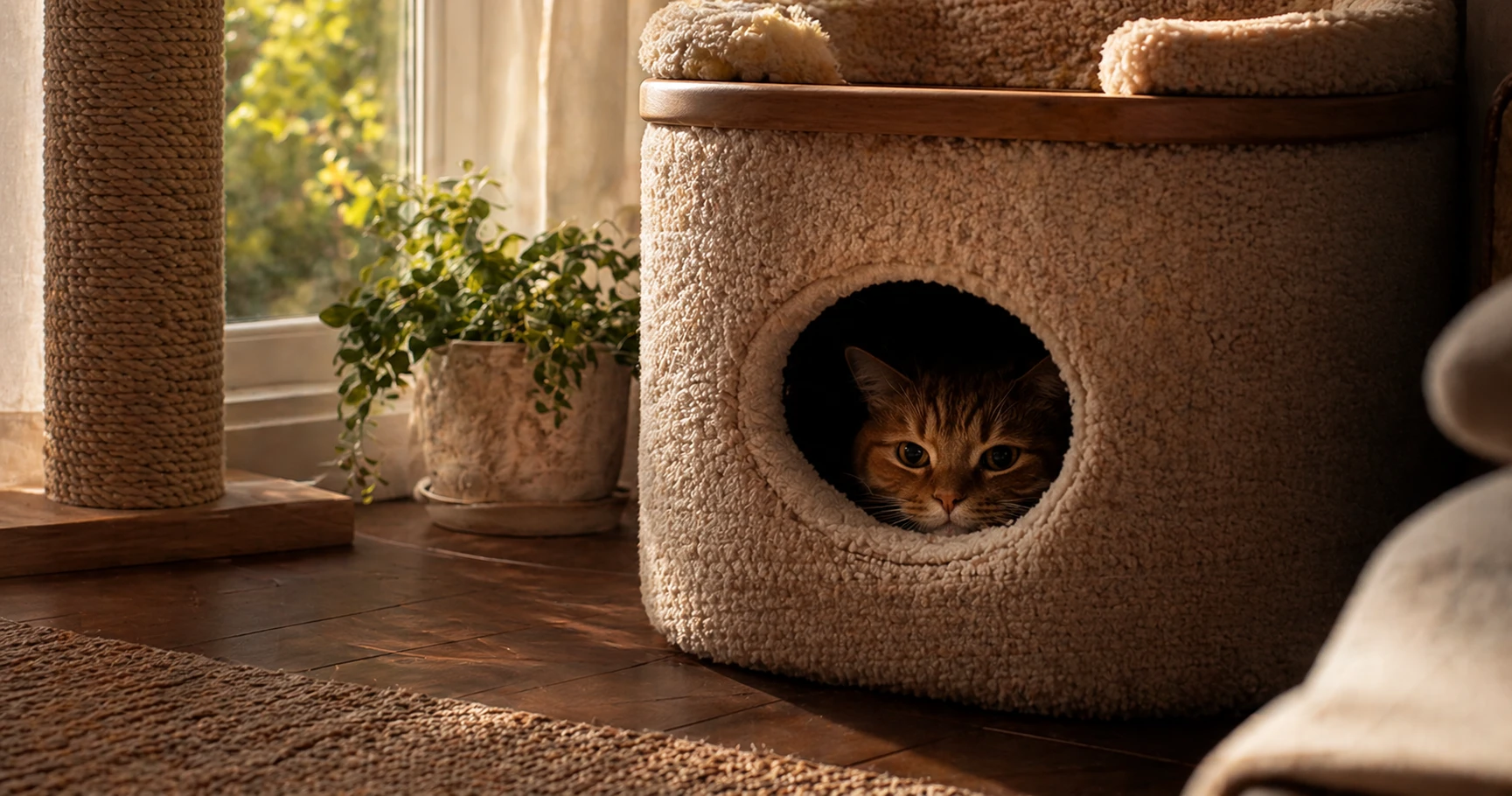
Some cats spend half their lives looking for a place to be invisible, and most homes do not have one. They hide under beds, behind appliances, inside closets -- anywhere with walls on more than one side and a clear sightline to the exit. If your cat does this, it is not a personality flaw. It is a need, and a cat condo that actually meets it will change where your cat spends its day.
Why Some Cats Need to Disappear
Hiding is not anxiety in cats -- it is management. A cat that retreats to an enclosed space is not falling apart; it is regulating. It has assessed the environment, decided the current level of activity or noise or social pressure is more than it wants to process right now, and removed itself. That is a healthy response. The problem is when a home gives that cat nowhere good to go -- nowhere purpose-built, stable, and reliably quiet -- so it ends up somewhere inconvenient for everyone.
The cats who use enclosed cat condos most are not always the obviously anxious ones. They include cats in multi-cat households who simply need a break from their housemates, cats in homes with children or frequent visitors, cats recovering from illness or a new environment, and cats who were under-socialized as kittens and have never been entirely comfortable in open space. What they share is a preference for walls, and an enclosed condo gives them that preference without the dust under the bed.
"The single thing I ask people to notice is where their cat goes when something stressful happens -- a visitor arrives, a loud noise, another cat gets too close. That destination tells you exactly what that cat needs. If it goes somewhere enclosed, it needs enclosure. An open cat bed or a perch will not substitute, because the cat is not seeking softness or elevation -- it is seeking walls. A condo gives it a place it chose, rather than a place it settled for, and that distinction matters more than people expect."

Fully Enclosed vs. Open-Top: It Is Not the Same Thing
A cat condo with an open top is not an enclosed space -- it is a box with a view, and for a cat that genuinely needs enclosure, that distinction is not subtle. An open top means overhead exposure, which is exactly the vulnerability a hiding cat is trying to eliminate. The entry hole matters too: a single circular opening gives the cat control over what can approach it and from which direction. Two openings, or an opening that is too large to monitor comfortably, removes that control and with it most of the security value.
Interior dimensions are the other variable that most product pages underserve. A condo that is too small forces the cat to curl tightly and cannot accommodate position changes -- which means the cat will use it for short stays but not settle in for hours. The right interior is large enough for the cat to turn around, stretch out on one side, and reposition without touching all four walls. For most cats, that means at least 14 inches in every interior dimension. For larger breeds, more.
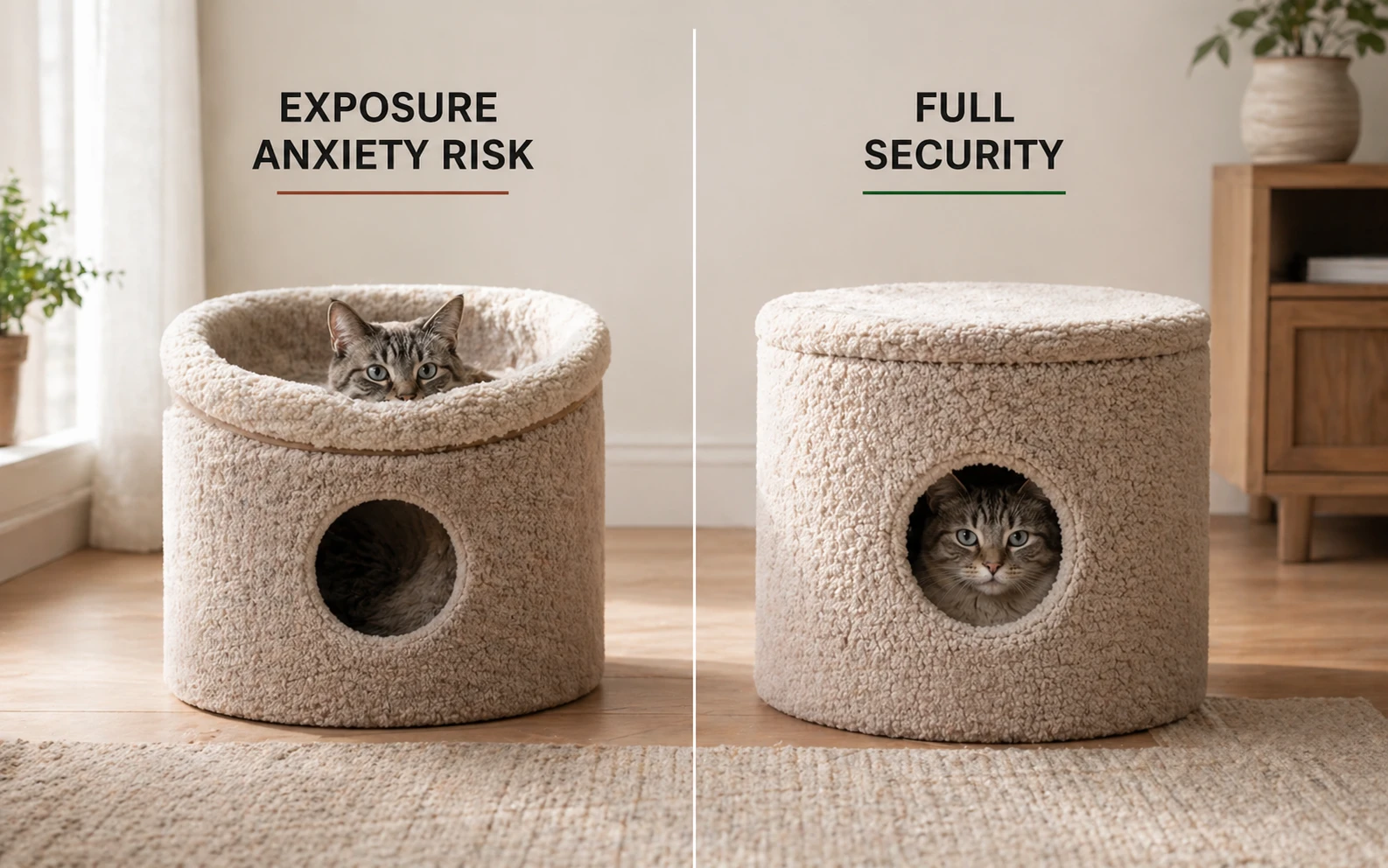
One gives a cat somewhere to sit. The other gives it somewhere to feel safe.
What Makes a Condo Useful Rather Than Decorative
The condos that get ignored are usually the ones that look right but are placed wrong. An enclosed condo on the floor in the middle of a busy room is not a retreat -- it is a condo with walls and no solitude. Placement matters as much as the product itself: against a wall, elevated enough to provide a vantage point, away from high-traffic paths, and positioned so the entry hole faces the room rather than a corner. A cat that can see what is coming before it commits to leaving is a cat that will actually commit to being inside.
For multi-cat homes, a condo is not optional -- it is infrastructure. A cat that has nowhere enclosed to go will displace that need onto the household in other ways: hiding in genuinely inconvenient spots, increasing conflict at shared spaces, or simply becoming less relaxed over time. A cat gym or cat tree handles the cats who want altitude and activity. The condo handles the cat who just needs the world to stop for a while.

"The condos I reject fastest are the ones that are styled to look cozy but built to be looked at. You can tell immediately -- the entry hole is decorative rather than functional, the interior is lined with fabric that will mat and trap odor within a month, and the structure flexes when you press on the walls. A cat that needs enclosure needs it to feel permanent and solid. I look for a rigid interior frame, a washable liner, and an entry hole sized for the cat -- not so small the cat has to squeeze, not so large it loses the den feeling. If it wobbles when you push it, the cat will know."

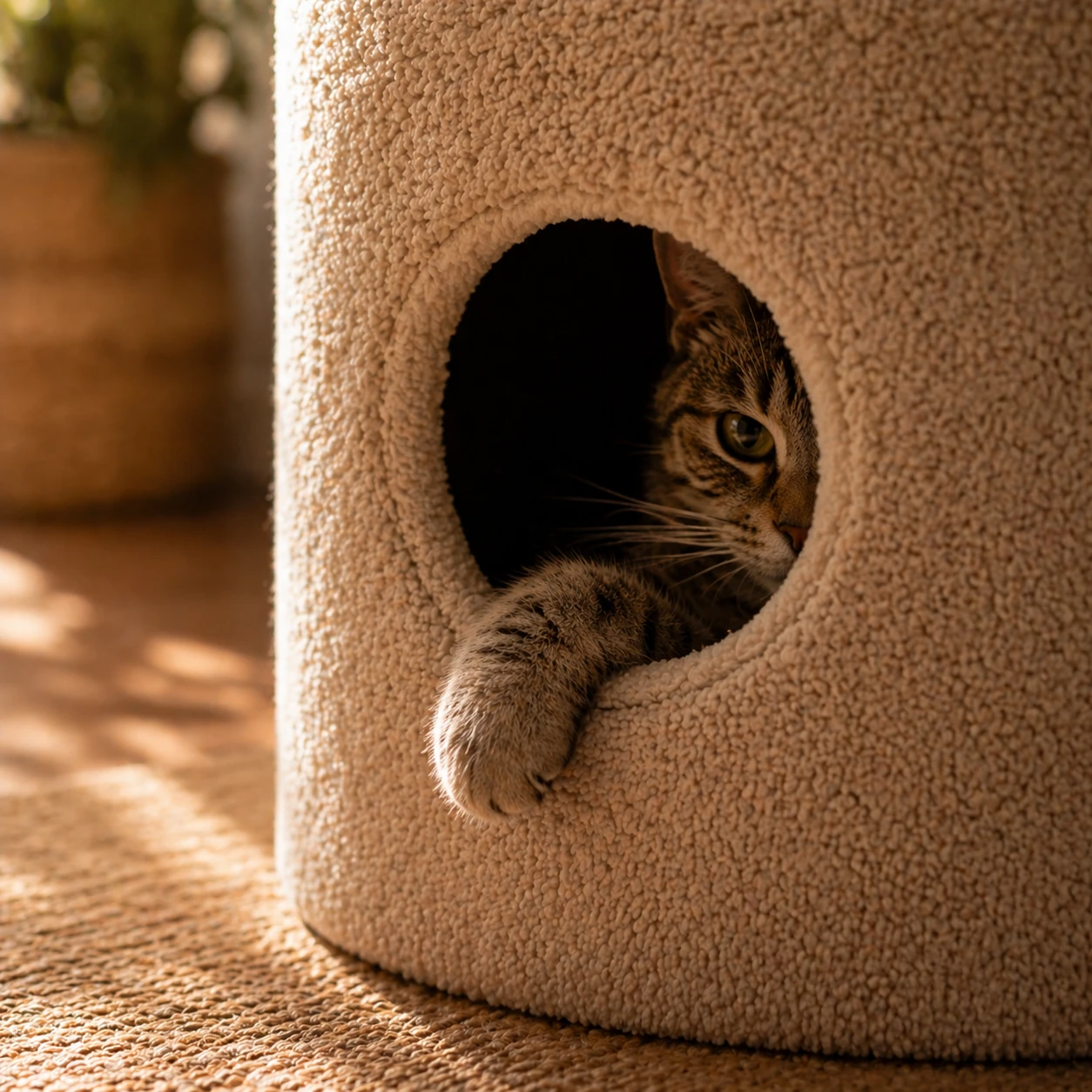
Shop enclosed cat condos and kitty condos: browse our cat condo collection -- fully enclosed options for cats who need real privacy, curated for structure, comfort, and lasting quality. Free shipping on everything.
For cats who are calmer or less active, the need for enclosed space often goes alongside a preference for lower, gentler furniture. Sarah's guide to choosing a cat gym for less active cats covers how to combine enrichment and privacy for cats who do both at their own pace.