

Apr 27th 2026
When Your Cat Slows Down: Rethinking the Cat Gym for Less Active Cats
Enrichment-first gyms for cats who take their time -- wide perches, low entries, calm by design.
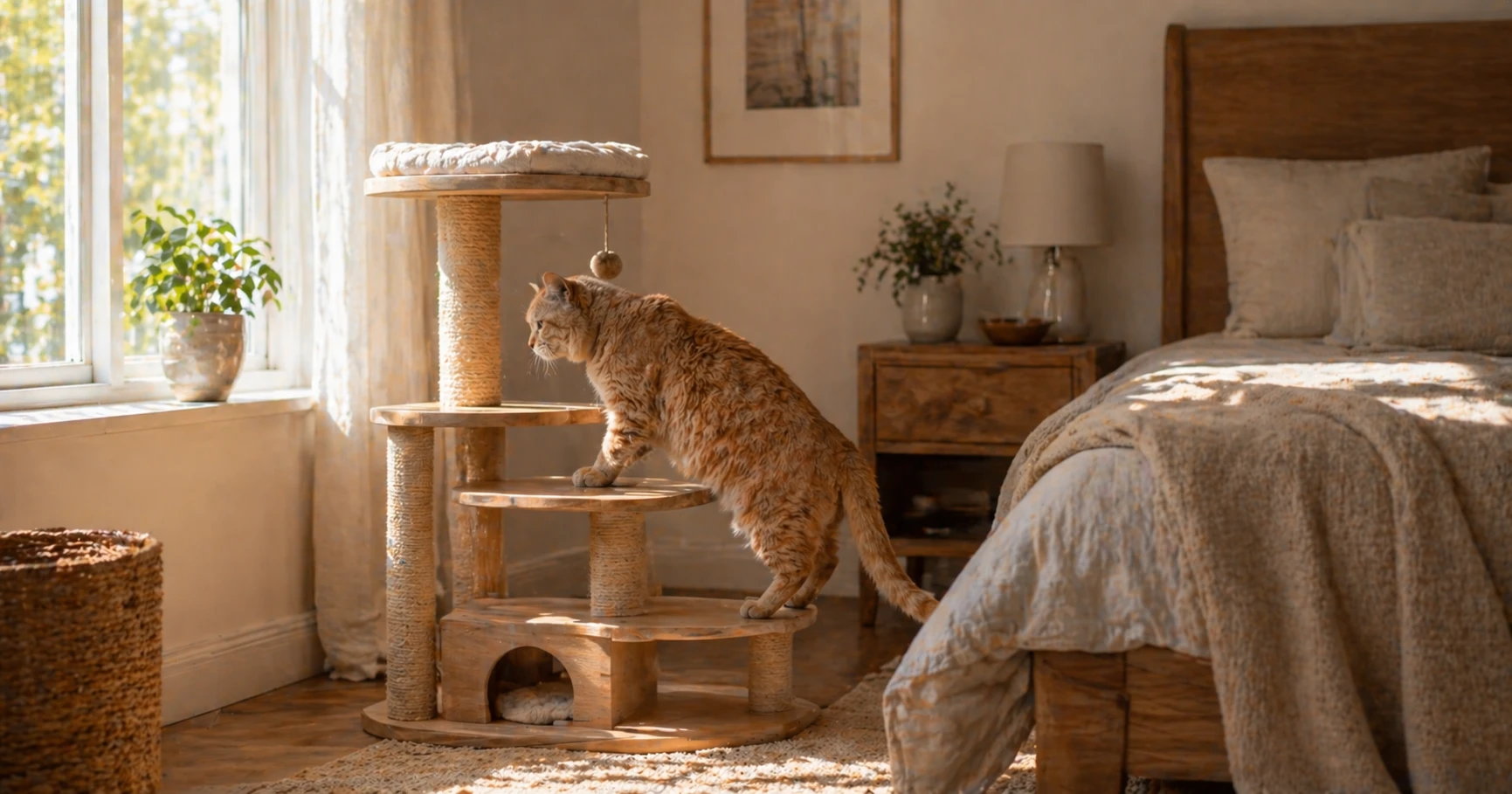
At some point the cat who used to launch itself to the top of the tallest thing in the room starts taking a different route -- slower, more deliberate, picking platforms it can step onto rather than platforms it has to leap for. That is not a cat giving up on its cat gym. That is a cat telling you what it needs the gym to be now, and the right response is not to remove the gym -- it is to find one that meets the cat where it is.
Enrichment Does Not Stop When the Sprinting Does
A less active cat still needs vertical space, visual territory, and somewhere to survey the room from above. These are not luxuries for athletic cats -- they are baseline needs that do not disappear with age or reduced mobility. What changes is how the cat accesses those spaces and how long it can comfortably occupy them. A senior cat that cannot get to the top perch is not a cat that has stopped caring about vertical space. It is a cat that has been locked out of it by a gym that was not designed with its current body in mind.
The instinct to retire the cat gym when a cat slows down is understandable but usually wrong. What that cat needs is a gym with lower first-step height, wider platforms for sitting rather than just perching, and gentler intervals between levels -- so the climb is an option, not a demand. Our full cat gym collection includes options designed with exactly this in mind.
"Older cats do not lose interest in their environment -- they lose access to it. And that loss is stressful in a quiet way that owners often miss because there is no dramatic behavior change, just a cat that sits on the floor more and seems a little flatter than it used to. When I see that, the first thing I ask is whether the cat can still get to the places it used to go. Returning access to elevation -- even modest elevation, even a 24-inch perch it can step onto -- often produces a visible shift in the cat's engagement with the room. They were not bored. They were stuck."

What the Spec Sheet Looks Like for a Less Active Cat
First-step height is the number that matters most and appears least often on product pages. For a cat with joint stiffness or reduced rear-leg strength, a first step higher than 10 inches is a barrier that will go unused after the first few attempts. Look for gyms where the lowest platform is accessible as a step rather than a jump -- ideally 8 inches or under from the floor, or paired with a ramp rather than an open gap. Cat steps placed alongside an existing gym can solve this without replacing the whole structure.
Platform width is the second spec to check. A less active cat does not perch -- it sits, sometimes for hours, and a narrow platform that requires constant balance adjustment is not comfortable for long stays. Platforms of 14 inches or wider allow a cat to shift position, tuck its paws, and settle fully without risk of slipping. Paired with low or absent lip edges -- so the cat can step onto the platform from the side rather than stepping over a raised border -- and you have a gym that a slower cat will actually choose to use.
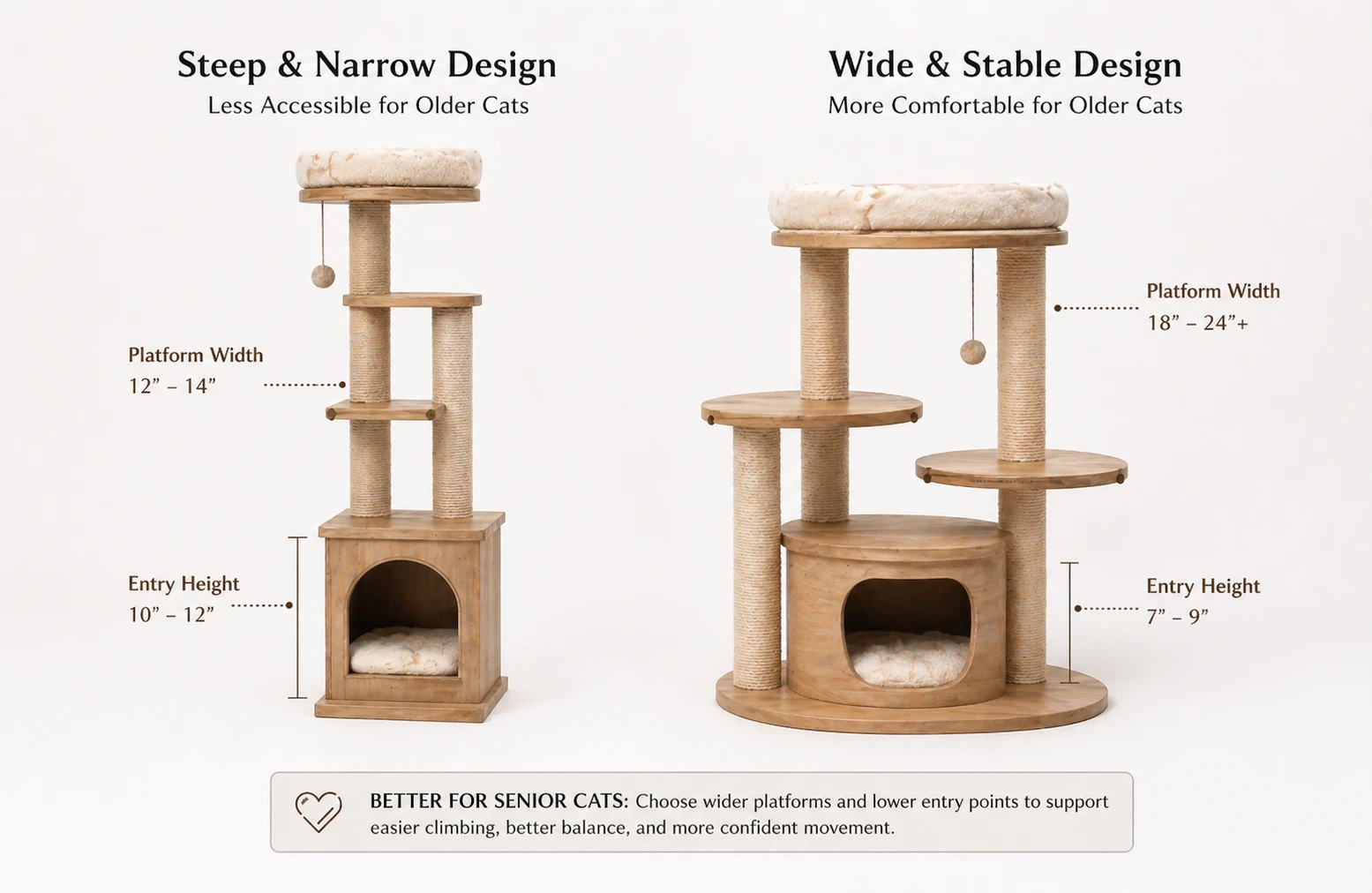
Same category, different demands. Platform width and entry height separate a gym for any cat from one for this cat.
Why Calm Design Is Not a Compromise
A gym designed for a less active cat is not a lesser gym -- it is a more considered one. Wide platforms, low entries, and gentle platform spacing require more structural engineering than a column of narrow perches stacked tall, because each platform needs to support a cat that is resting its full weight rather than briefly touching down between jumps. The materials matter too: plush surfaces that are easy on joints, platforms with enough give that a cat landing carefully does not jar itself, and a base stable enough that nothing shifts when the cat repositions slowly at the top.
For cats who also need a private retreat alongside their climbing space, a gym that incorporates an enclosed cat condo at a low, accessible level handles both needs in one structure -- the cat gets elevation, enrichment, and a door to close the world out, all without having to navigate between separate pieces of furniture.

"When I am curating for a senior or less active cat, I am looking for three things in the spec sheet: first-step height under 10 inches, platform depth of at least 14 inches, and a base wide enough that the structure does not rock when a cat puts all its weight on one side slowly. That last one matters more for less active cats than people expect -- a younger cat corrects for a wobble instinctively, an older cat may not. The gym that works for a ten-year-old cat is the one that never asks anything of the cat it cannot comfortably give."

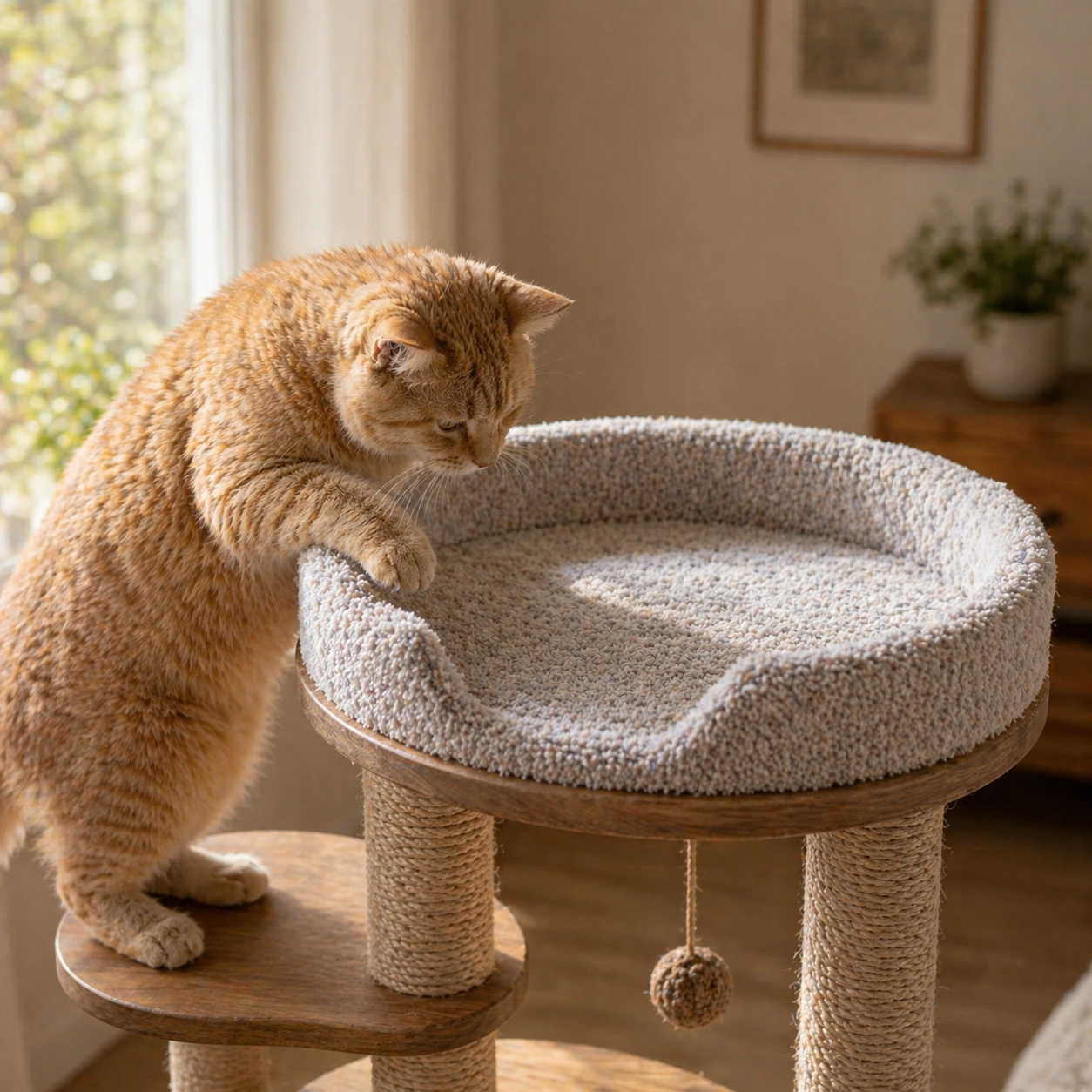
Shop cat gyms for every activity level: browse our full cat gym collection -- wide perches, low entry options, and multi-level designs that work for cats who take their time. Free shipping on everything.
Less active cats often need both enrichment and privacy -- a place to observe without having to climb. Sarah's guide to cats who need enclosed space covers the behavioral reasons some cats want to disappear rather than survey from a perch -- and how to choose furniture that gives them both options.