
May 23rd 2026
Cat Wall Furniture for Design-Conscious Homes
The cat furniture your home has been waiting for -- and your cat will actually use.
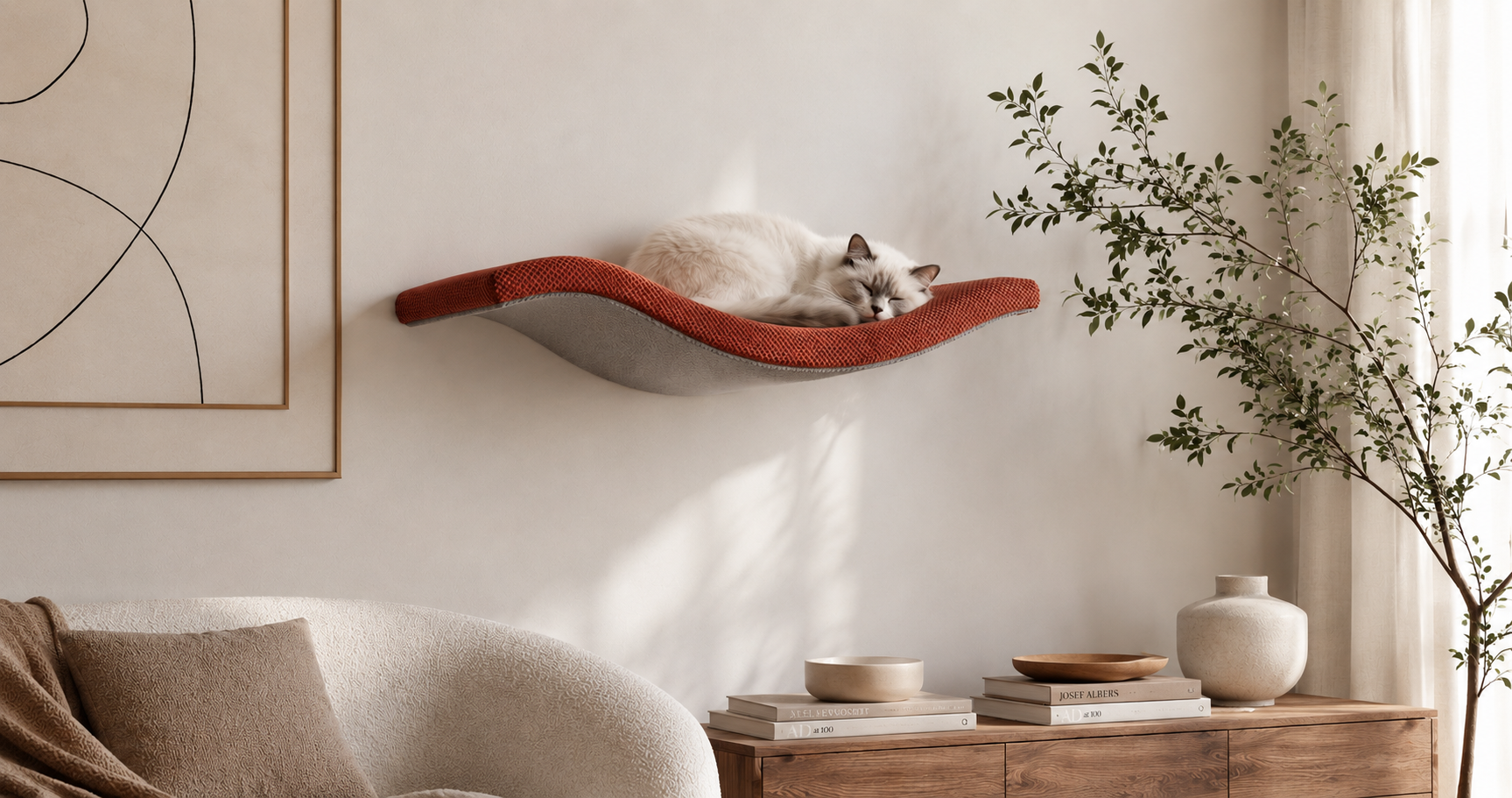
You did not spend years getting your home to look the way it does so that a beige carpet tower with five dangling pom-poms could move into the corner of the living room. The good news is you do not have to choose between your cat and your room -- but you do have to know what to look for. Cat wall furniture has come a long way, and the best pieces are genuinely designed objects that happen to be perfect for cats.
What Separates Design-Forward Cat Furniture From Everything Else
The answer is not price, and it is not the word "premium" in the product name. It is whether the piece was designed with both occupants in mind -- the human who has to live with it and the cat who has to use it. Most cat furniture is designed for cats first and tolerates the human's presence. The pieces that belong in a well-designed room started with the question: what would look intentional here? Natural materials, clean lines, and hardware that disappears are the three markers that separate the category from everything else on the market.
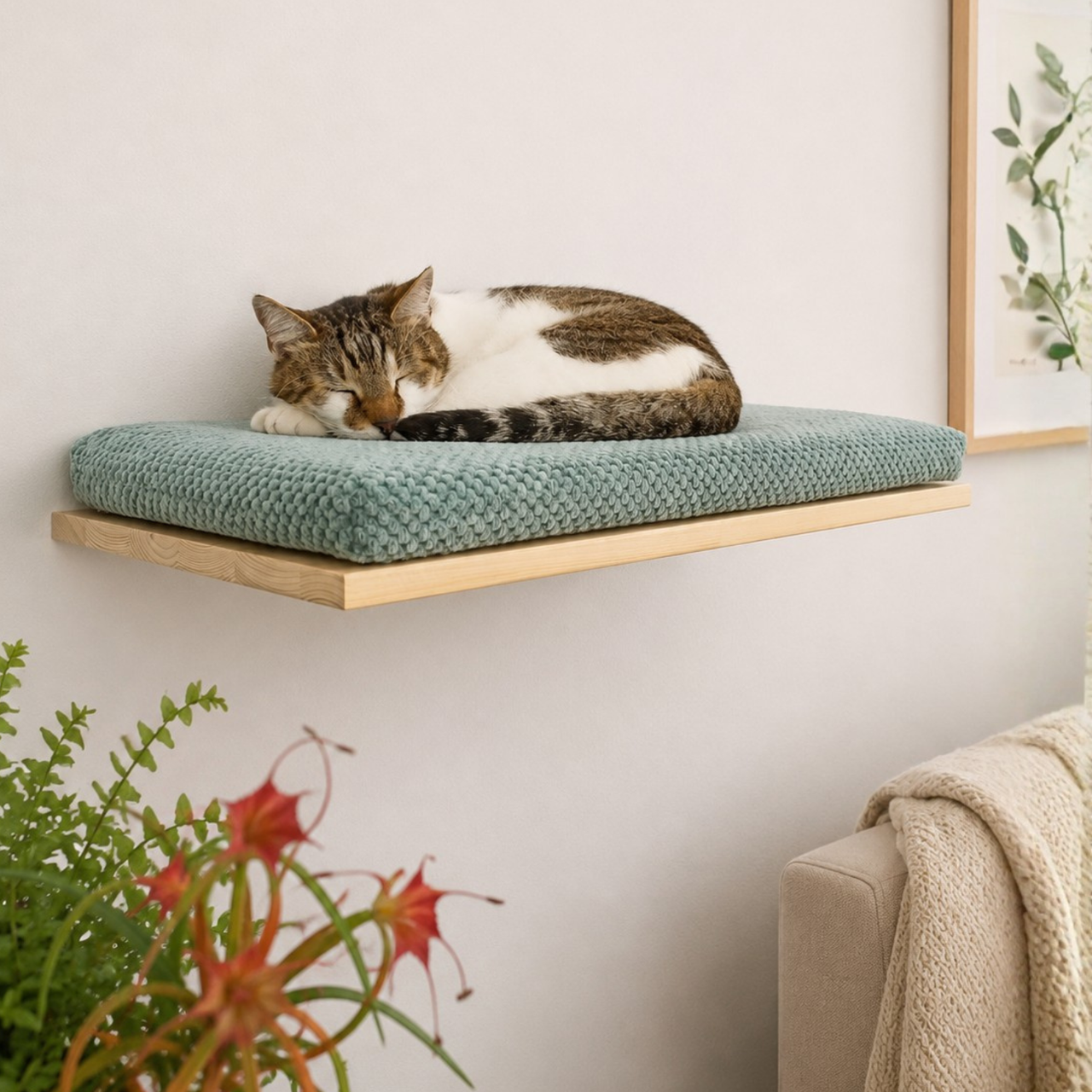
Practically, that means solid wood rather than particle board, fabric cushions in colors that exist outside a pet store, and mounting systems that read as architecture rather than installation. Wall-mounted cat shelves do this particularly well because they take the piece off the floor entirely -- which is where most cat furniture loses the room. A shelf that floats on the wall with no visible hardware is not making a concession to having a cat. It is making a design choice.

"The test I use is simple: would I want this in my home if I did not have a cat? If the answer is no, I do not carry it. I go to the spec sheet before I look at a single photo -- every time. The photo is marketing; the spec sheet is the truth. What I am looking for is whether the designer thought about where this piece lives in a room, not just what a cat does on it. The pieces that pass that test share a few things: natural materials, proportions that make sense, and mounting or base design that does not fight with the furniture around it. Everything else is a cat tree wearing a nice color."

The Pieces That Actually Pull It Off
The clearest example is the European wall shelf category -- specifically the handcrafted Polish designs that use invisible mounting hardware, curved wood forms, and removable cushions in fabric colors treated as a genuine design variable. The Crescent Cat Wall Shelf mounts with no visible screws or brackets -- it reads as architecture from across the room. The Flow shelf uses a metal base that doubles as a design element rather than hiding it. Both have removable cushions available in 15 fabric colors so the shelf coordinates with the room rather than the other way around.
The Cozy Nook takes a different approach -- a flat solid wood shelf with a deep plush cushion that sits flush to the wall and looks, from a distance, like a floating architectural ledge with a cat on it. Bookshelf-integrated cat trees are the other category that consistently earns its place in a well-designed room -- a unit that holds books at the lower levels and gives your cat vertical territory at the upper levels solves two problems without making either look like an afterthought.
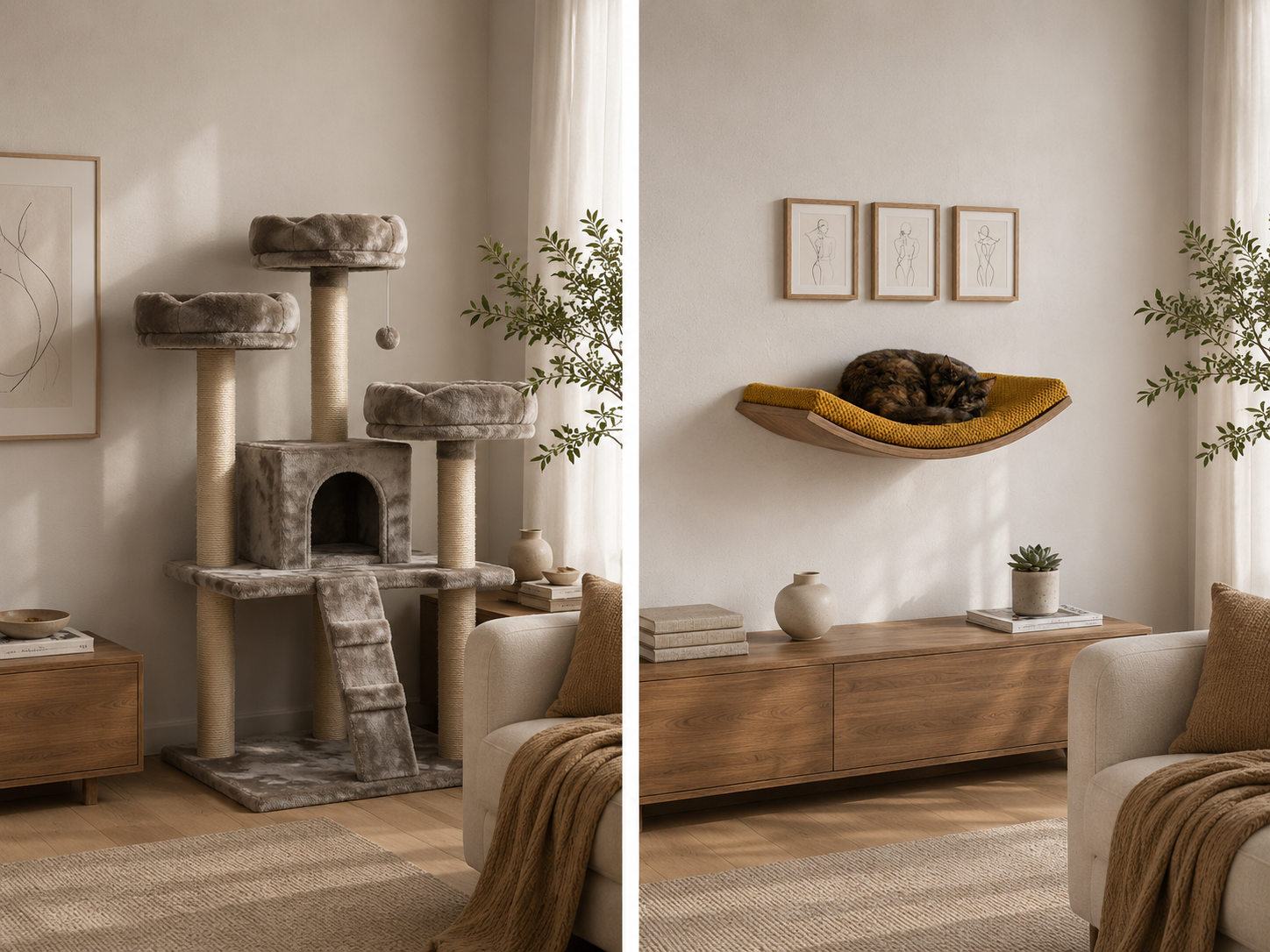
The same room, two different choices -- one announces itself, one belongs there.
The Detail That Most Buyers Miss
Cushion quality and replaceability. This is not glamorous, but it is the detail that separates a piece that still looks good in three years from one that starts to look worn and unhappy by month six. A fixed cushion in a synthetic fabric that cannot be removed or washed is not a design-forward piece -- it is a piece that will photograph well and age badly. The pieces worth carrying have removable cushions in fabrics that hold their look, and ideally cushions available in multiple colors. Every shelf in our cat wall furniture collection meets this standard -- the cushion is a replaceable, washable component, not a fixed feature.
Mounting depth is the other thing worth checking. A floor-standing cat tree that is 18 inches deep does not need to be -- most solid designs achieve the same structural stability at 12 to 14 inches, which is the difference between something that fits against a wall and something that juts into the room. Wall-mounted shelves solve this completely by removing the floor footprint entirely -- there is no base to trip over, no depth to negotiate, just a shelf on the wall that happens to have a cat on it.
"The placement question is actually a behavioral one, not just an aesthetic one. Cats use furniture most when it is placed where they already want to be -- near a window, near the family, along a natural travel route through the room. A beautiful shelf on the wrong wall will sit unused. The pieces that work in well-designed rooms also tend to be the pieces cats adopt most readily, because they are placed where they actually belong in the room's flow rather than tucked into corners where they are easy to ignore. Good design and good cat behavior often point to the same answer."

If you're ready to take the next step, our guide on how to style cat wall shelves like an interior designer covers placement, spacing, and how to make a wall system look intentional. And if you're considering furniture that serves both you and your cat, home furniture that doubles as cat furniture explores the pieces that work for both without compromise. Browse our full cat wall shelves collection to find pieces that belong in your home.