Mar 24th 2026
Buying furniture for BIG breed cats has special considerations
If your cat is a giant breed, "sturdy" is only half the battle. Discover the ergonomics of scale and why your cat's range of motion depends on the right architecture.
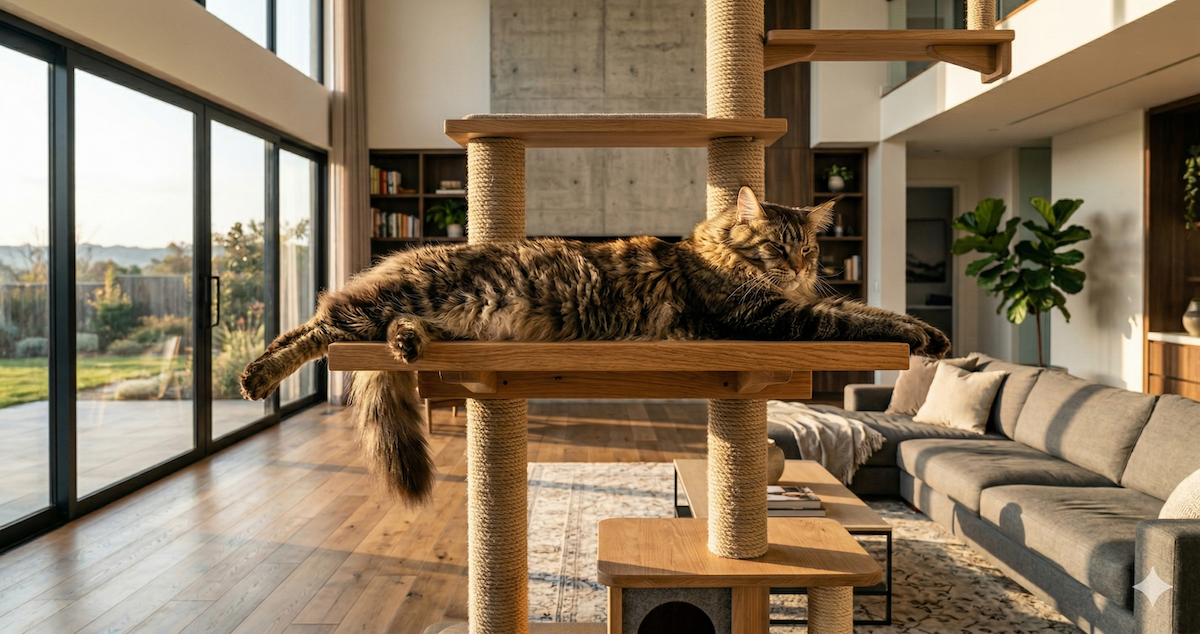
A true giant breed perch should allow for a full-body sprawl without limbs hanging over the edge.
Most manufacturers slap a "heavy-duty" label on a cat tree simply because they used thicker carpet or an extra screw. But when you are buying for a Maine Coon, Ragdoll, or Norwegian Forest Cat, you aren't just managing weight—you are managing scale. A 20 pound cat has a different center of gravity, a longer spinal column, and a much wider turning radius than a standard tabby. To ensure long-term health, we apply an Ergonomic Audit to all our large breed selections, focusing on how the furniture supports their actual physical dimensions.
1. Spinal Alignment and the "Sprawl Factor"
Standard cat perches are typically 12 to 14 inches wide. For a large breed cat, this forces them to sleep in a permanently "scrunched" position, which can lead to chronic joint stiffness and spinal compression over time. Our audit requires oversized perches with a minimum width of 24 to 30 inches. This "sprawl factor" allows the cat to lie completely flat, maintaining neutral spinal alignment during deep sleep—the same way an orthopedic bed supports a large-breed dog.
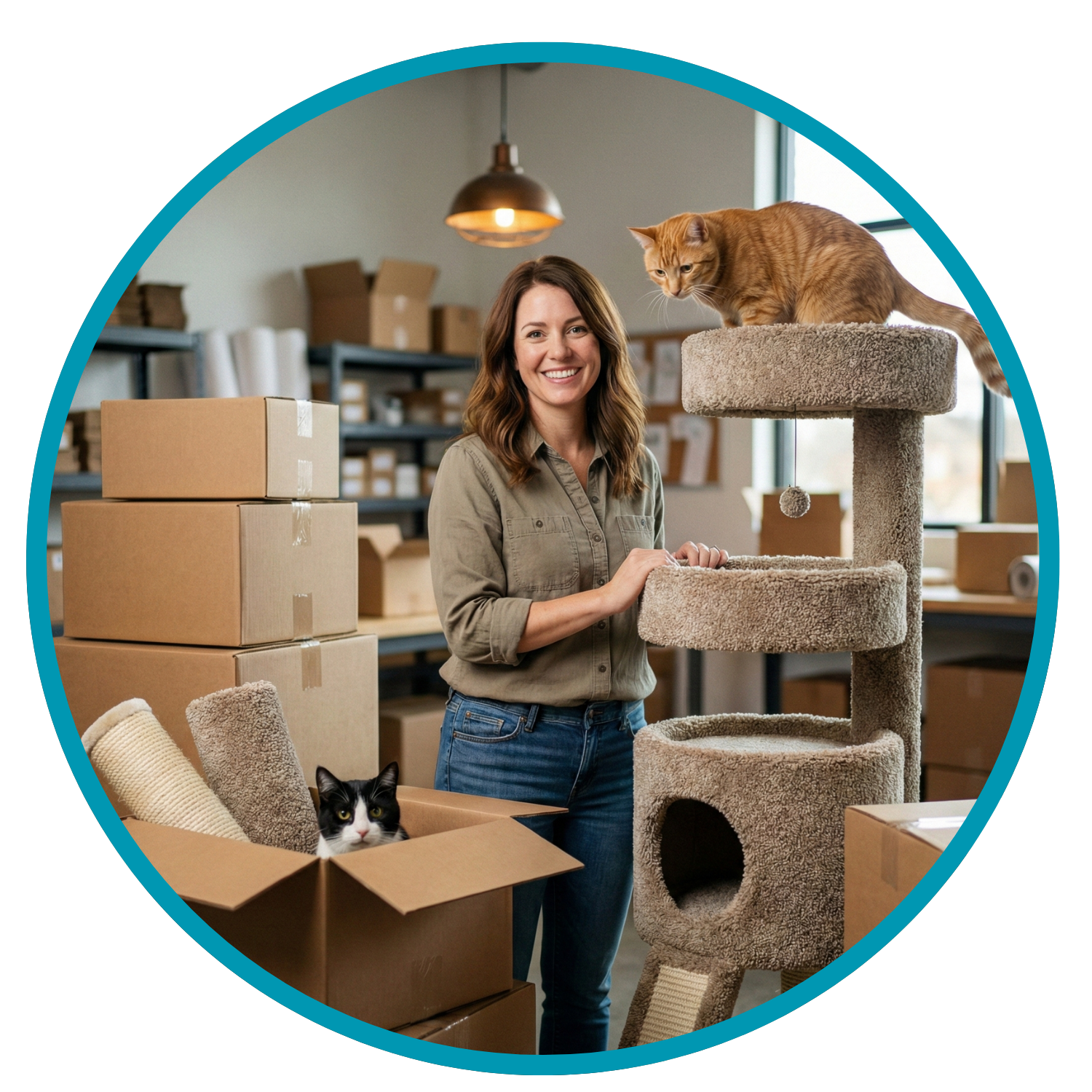
"In my Ergonomic Audit, I look at 'postural confidence.' A large cat who doesn't feel fully supported will often avoid high perches because they fear rolling off in their sleep. When you provide a sprawling, solid wood surface, you'll see a behavioral shift—the cat becomes more relaxed and spends more time in their 'elevated' territory because the furniture finally fits their frame."

2. Vertical Scaling: The "Full-Stretch" Requirement
One of the most overlooked considerations for large breeds is the height of the scratching post. A Maine Coon can reach 35 to 40 when fully extended. If the scratching section of a cat tree is interrupted by a platform at 24 inches, the cat cannot get a full vertical stretch. This leads to them seeking out your taller door frames or sofa corners instead. Our various furniture styles for big cats prioritize uninterrupted sisal sections of at least $40\text{ inches}$ to accommodate this massive reach.
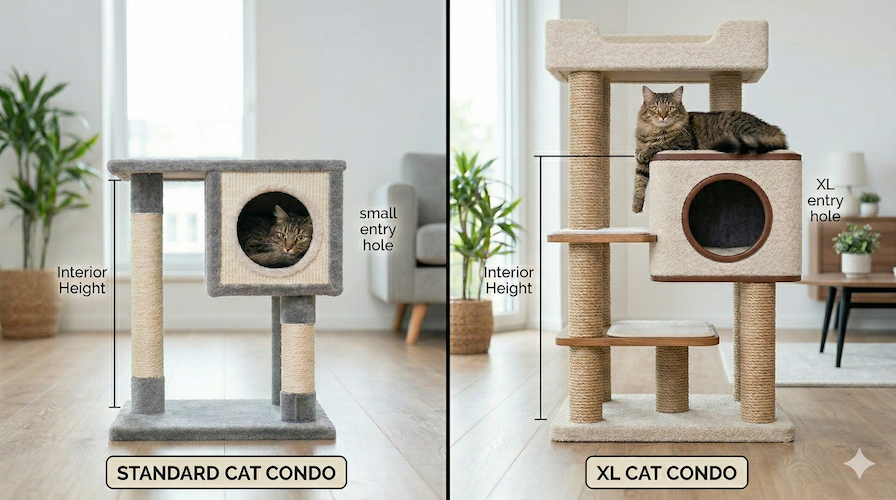
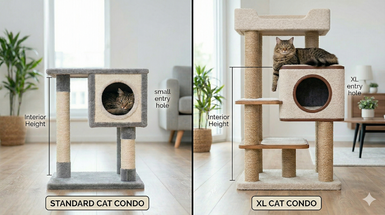
Interior volume is critical—large breeds need wider entry holes and deeper condos to turn around comfortably.
3. The Physics of the "Lever-Load"
When a 10 pound cat jumps, the force is manageable. When a 22 pound cat launches from a 5 foot height, they exert massive lateral torque on the central support. Brian’s Audit focuses on the "Lever-Load"—the engineering required to keep the unit from snapping at the base under this dynamic pressure.
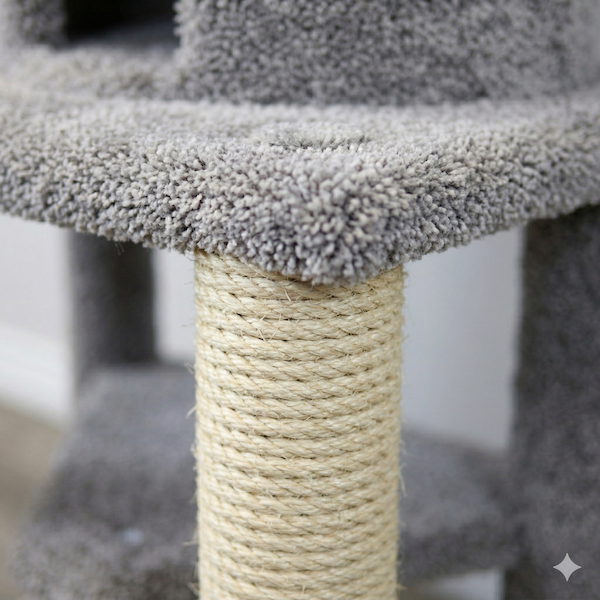
Massive $5\text{-inch}$ posts are required to absorb the kinetic energy of a large cat.
Post Diameter: We strictly audit for support columns with a minimum 4.5 to 5 inch diameter. These wider columns provide the surface area needed for a rock-solid connection to the base.
Condo Volume: For large breed cats, a "condo" is often just a box they can’t fit into. We look for entry holes of at least 10 to 12 inches in diameter and interior floor space of 20 x 20 inches or more.
Solid Wood Cores: To prevent the structure from teetering, we prioritize solid wood cat trees. The density of the wood allows for deeper hardware threading, which prevents the "bobblehead" effect common in cardboard-based towers.
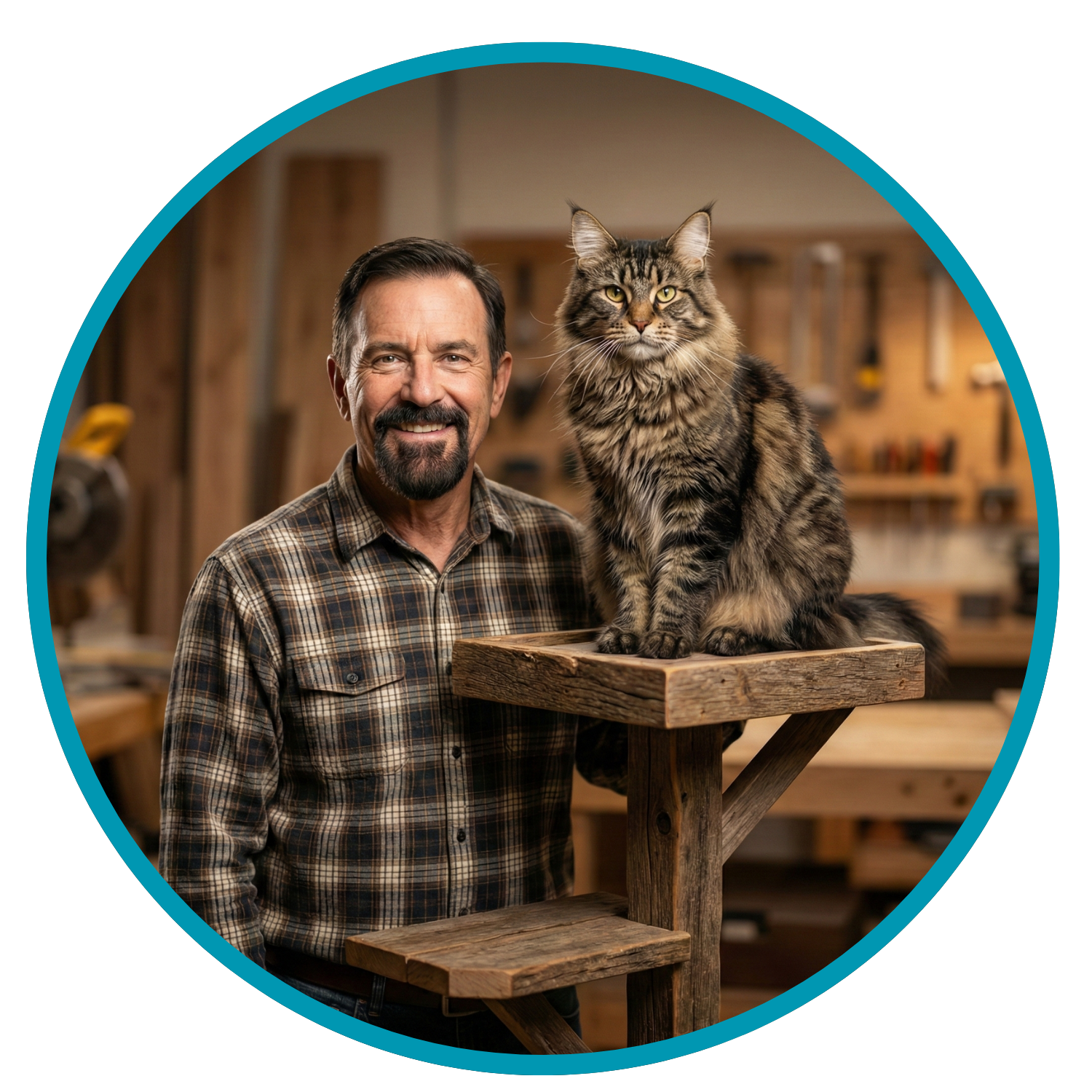
"When I conduct a Structural Quality Audit for a 'Big Cat' unit, I test for what I call 'joint fatigue.' If you use standard 3 inch posts, a Maine Coon’s daily use will actually pull the hardware loose from the particleboard within a year. We audit for .75 inch plywood and 5 inch posts because you need that extra density to hold the heavy-duty bolts that keep the structure stationary."

Ready to Level Up for Your Giant Breed?
Stop trying to fit a Maine Coon into a tabby-sized world. Explore our curated range of large breed cat furniture, audited for the scale, strength, and ergonomics your cat deserves.